
How to Check Criminal History in Waterloo
Start by naming the event and the proof you need. Waterloo Police can locate a village incident report, but it cannot certify the outcome of a prosecution. Waterloo Village Court or Waterloo Town Court can identify a local docket. County Court handles felony trials. Corrections in Romulus can confirm current county-jail custody, while DCJS Personal Record Review is the route for a fingerprint-supported copy of your own New York history.
- Identify whether Waterloo Police, the Sheriff, or New York State Police responded in Waterloo.
- Ask the Waterloo responding agency for the incident report, using the date, place, person, and report number.
- Read the Waterloo appearance ticket to distinguish Waterloo Village Court from Waterloo Town Court.
- Call county booking for present Waterloo custody, or County Court when a Waterloo felony complaint moves there.
- Use DCJS Personal Record Review when the goal is your own official statewide history tied to a Waterloo arrest.
Do not treat a same-name result as proof of identity. A docket, booking file, and DCJS arrest cycle serve different purposes. The full Seneca County criminal court case process provides more detail once the correct court is known.
Waterloo Police Records at Main Street
Village offices and Waterloo Police share 41 West Main Street. The village lists its main office at 315-539-9131 and Police at 315-539-2022. A county directory has also listed 315-539-2501 for Police, so the sound course is to confirm the current records number through the village office before relying on an older directory. The village names Chief James Chechak and publishes waterloopd@waterloopd.org.
The official Waterloo Police page is the source for the local department. Its captured view appears below.
This Waterloo department page establishes the proper first stop for a report made by a Waterloo officer. It does not replace a Waterloo court docket or county booking record.
The Waterloo Police Department
Waterloo Police creates reports for incidents its officers investigate. DCJS lists the agency as accredited since 2023 and records 16 full-time sworn personnel. That accreditation is useful agency context, but it does not mean the department runs a public criminal-history database. Research found no dedicated online report portal, request form, or complete arrest blotter.
Request a Waterloo report directly from Police or use the Waterloo village clerk's FOIL route. Supply a focused description: requester and contact details, incident type, date, Waterloo location, involved person, report number if known, and the preferred delivery format. If a deputy or trooper handled the Waterloo event, contact the Sheriff or New York State Police instead. Records stay with the agency that created them even if the person was later booked in the same county jail.
Verify Waterloo Police Record Contacts
Two published phone numbers create a small but real search trap. The village Police page lists 315-539-2022, while a 2025 county directory lists 315-539-2501. Neither discrepancy proves that a record is unavailable. Call the Waterloo village office at 315-539-9131 during its posted weekday hours and ask which line now handles police-record requests.
Once connected, ask whether an ordinary Waterloo copy request is enough or a written FOIL request is required. Describe the Waterloo record rather than asking for a general background check. Waterloo Police staff can search an incident number or date range more reliably than an undefined request for everything tied to a name.
Arrests and Bookings in Waterloo
A Waterloo arrest can create separate records in several places. The arresting officer writes the incident and arrest report. If detention is required, the Seneca County Correctional Facility in Romulus creates the booking file. A fingerprintable misdemeanor or felony is sent to the DCJS State Identification Bureau. A local court or the Centralized Arraignment Part then creates the first court entries.
Call Corrections at 315-220-3469 for current county-jail custody after a Waterloo arrest and a booking number when appropriate. The Sheriff's older mobile-app description advertises real-time inmate search, yet no dependable browser roster was verified. Phone confirmation is the safer Waterloo fallback. An absence from the Sheriff's selected news releases does not show that no Waterloo arrest occurred.
Charges may change after the prosecutor reviews the case. A booking record proves custody, not guilt, and the court of original jurisdiction is the place to request a certificate of disposition. More county-wide custody channels appear in the Seneca County arrest history resource.
Waterloo Village and Town Court Records
Waterloo has two similarly named justice courts. Waterloo Village Court sits at 41 West Main Street and uses 315-539-2512. Waterloo Town Court is separate at 66 Virginia Street and uses 315-539-3213. The court named on the appearance ticket, bail receipt, or release paper controls. Calling the wrong clerk can lead to a truthful “no record” answer even though a file exists nearby.
Both courts may handle misdemeanors, violations, traffic matters, and the early stage of a felony complaint. A felony trial belongs in Seneca County Court at the county courthouse. The New York Find-a-Court tool can filter by case type, court type, county, and an option to include town and village courts. It locates an office, not the docket itself, so direct clerk contact remains essential.
Waterloo Municipal Court Records
Ask the identified clerk for the docket and the specific paper needed. Common requests include an accusatory instrument, an order, a disposition entry, or a certificate of disposition. A certificate is the court's certified statement of the outcome. It is more useful than a police release when proof of the final result matters.
| Court Name | Waterloo Village Court, distinct from Waterloo Town Court and Seneca County Court. |
|---|---|
| Case Types Heard | Waterloo village misdemeanors, violations, traffic matters, and preliminary felony proceedings within local jurisdiction. |
| Case Lookup Channel | Call or visit the Waterloo clerk; Find-a-Court locates the office but does not expose the case file. |
| What the Docket Shows | Waterloo docket number, charges, appearances, orders, plea or verdict, disposition, sentence, and any warrant notation. |
| Copies & Fees | Confirm the Waterloo document, certification, delivery method, and current fee with the court before ordering. |
Sealed cases, youthful-offender matters, and protected victim or minor information are excluded from ordinary public access. For older or non-electronic material, ask whether inspection or mail service is available.
Reading Waterloo Arrest Record Trends
DCJS's older Uniform Crime Reporting series counted 167 Waterloo index crimes in 2015 and 52 in 2019. The 2019 total included one violent and 51 property crimes. Those property entries consisted of 11 burglaries, 38 larcenies, and two motor-vehicle thefts. The source file was produced in 2020.
These figures describe reported index offenses in past years, not all police calls, all arrests, or current safety. They also do not reveal whether a given report led to charges or conviction. Use them as historical context only. The Census QuickFacts service offers broader population context, while a person researching a particular Waterloo matter still needs the incident report and the correct court file.
Where Waterloo Records End Up
Waterloo Police keeps the incident narrative it created. County Corrections keeps a booking record if the person entered the Romulus jail. The proper justice court records initial filed charges and appearances, while County Court takes over felony prosecutions. Courts and prosecutors report qualifying outcomes to DCJS so the statewide arrest cycle can be updated.
Record flow: Waterloo Police Department › Seneca County Courts › New York State Division of Criminal Justice Services
Timing matters in Waterloo. A new Waterloo police report may exist before a case appears at a clerk's counter. Later, the filed charge can differ from the Waterloo arrest charge. A DCJS personal record may remain incomplete until the Waterloo court outcome matches the fingerprint event. Keep the docket number and obtain a certified disposition when correcting your own record.
Waterloo Criminal Records at County Seat
Waterloo is both the largest incorporated village in Seneca County and the county seat. That places village offices, Village Court, the District Attorney, and County Court within the same community, but each remains a separate custodian. The District Attorney prosecutes local crimes from 44 West Williams Street. The Supreme and County Court clerk is at 48 West Williams Street. The County Clerk works at 1 DiPronio Drive.
The official District Attorney page supplied one of the assigned Waterloo source images.
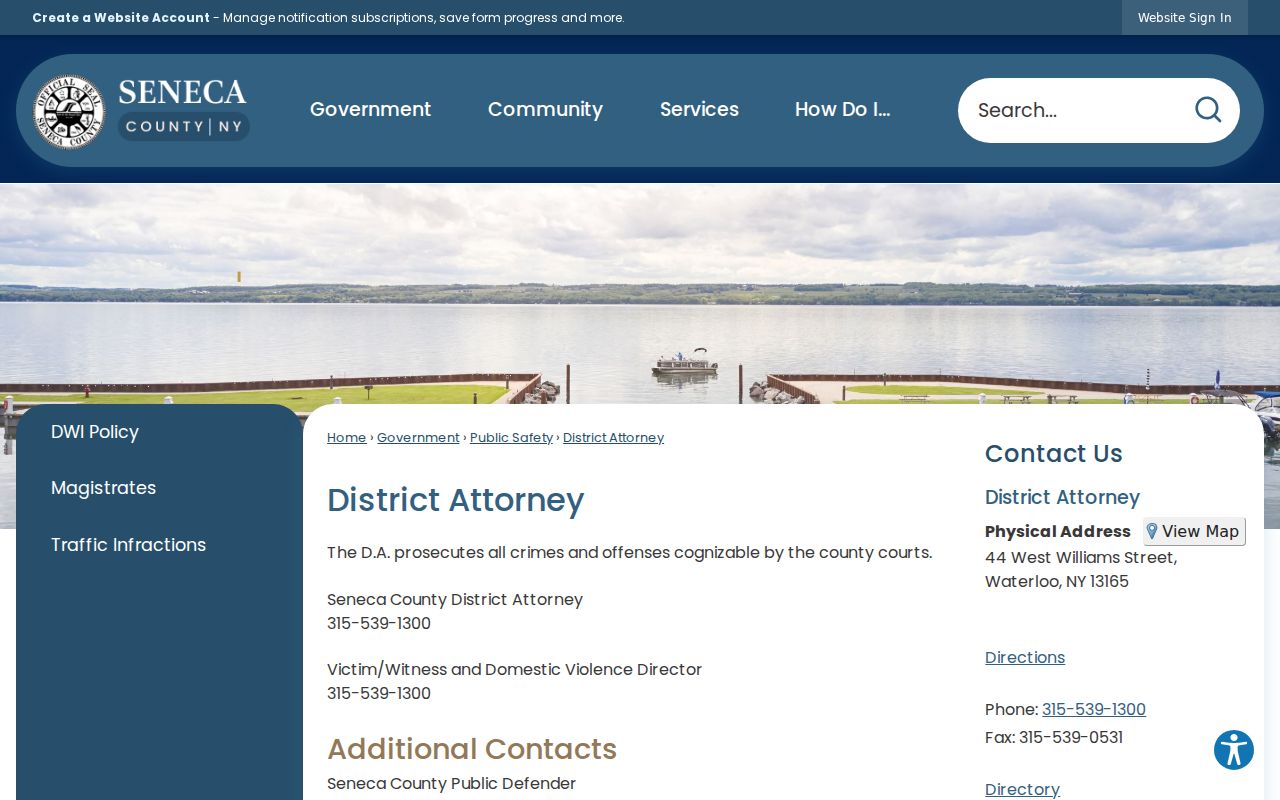
The Waterloo image reinforces why a prosecutor contact is not a substitute for the Waterloo court clerk. Prosecutor releases can explain a case, while the certified Waterloo outcome remains with the court.
Waterloo's county-seat role grew from a much older transport center. Seneca River mills, the turnpike, the Cayuga-Seneca Canal link to the Erie Canal in 1828, and the railroad arrival in 1841 helped place civic records in a busy village. The Hunt House is tied to planning for the July 1848 women's-rights convention, and Waterloo also anchors the documented 1866 through 1868 Decoration Day story that shaped Memorial Day observance. Those milestones do not change modern access law, but they explain why Waterloo holds both village records and key county offices within a small area. A historic reference may use an old office or court label. Record requests should include the event date so staff can distinguish historic Waterloo material from an active office file. Current Waterloo criminal records still require the present Police, Village Court, Town Court, County Court, or county custodian named by the document.
Waterloo Probation Record Boundaries
Seneca County Probation and Community Corrections is at 1 DiPronio Drive in Waterloo and can be reached at 315-539-1740. A public court docket may show that probation was imposed. Officer notes, treatment facts, and supervision details are restricted rather than open name-search material. State parole is separate, with authority described by the New York State Board of Parole.
The county Probation page is the source for the assigned department image.
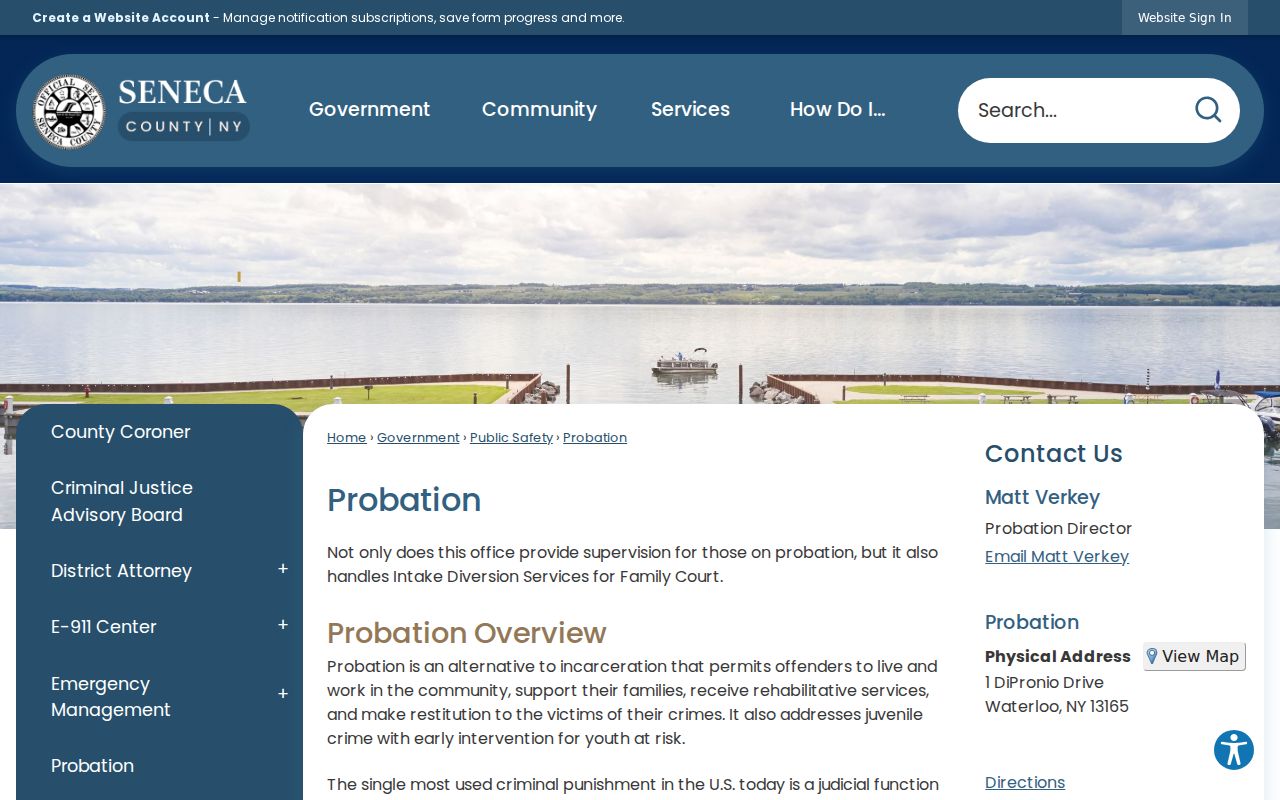
This Waterloo county office may clarify supervision administration, but the Waterloo court of conviction remains the source for the sentence and certificate of disposition.
Public Access Rules
Waterloo police records begin with a focused Waterloo village request under FOIL. Waterloo court files begin with the clerk because Judiciary Law section 255 and court rules govern the clerk's search and copy duties. Neither Waterloo route opens sealed cases, youthful-offender files, protected personal data, or law-enforcement material whose release would interfere with an active matter. Ask for reasonably segregable public portions if part of a Waterloo report is exempt.
Key Statutes:
Public Officers Law Article 6 gives access to agency records subject to FOIL exemptions and supplies request and appeal procedures.
Judiciary Law § 255 directs court clerks to search, copy, and certify court records when authorized.
Executive Law § 837 assigns criminal-history duties to DCJS without creating a public rap-sheet name search.
CPL 160.50 seals records after a case ends in favor of the accused, subject to stated exceptions.
CPL 160.59 permits court-ordered sealing of certain eligible convictions after statutory review.
For an agency request, New York law generally requires a response, denial, or acknowledgment within five business days. That is not a five-day production guarantee. Complex video, redaction work, and active investigations can take longer.