
Criminal Cases in the Seneca County Courts
Seneca Supreme and County Court sits at 48 West Williams Street in Waterloo. The New York court jurisdiction summary explains that County Court is the only local trial court that can try felonies. Seneca County Court, town courts, and village courts share authority over misdemeanors and lesser offenses. A Seneca County town or village justice court may arraign a felony complaint, yet the felony prosecution later moves to County Court. That handoff is why the first court name on arrest paperwork may not be the Seneca County court holding the later indictment or disposition.
Supreme Court shares the building, but the official Seneca court description assigns local criminal prosecutions to County Court. The Seneca County clerk can be reached at 315-835-6229, Monday through Friday from 9:00 a.m. to 5:00 p.m. Ask for the criminal docket or a named document. An undefined request for a background check does not tell the clerk which file or product is needed.
Twelve Seneca County Criminal Courts
Seneca County has County Court plus eleven town and village justice courts in the research inventory. Location points to a likely court, but it does not settle file custody. Waterloo alone has distinct town and village courts. Covert Town Court serves from Interlaken, while Ovid Town Court listings use addresses rendered inconsistently in the state directory. The safest approach is to read the court name from the appearance ticket, bail receipt, or release document, then call that Seneca County clerk before traveling.
Seneca County Court
48 W. Williams St.
Waterloo, NY 13165
315-835-6229
Weekdays, 9:00 a.m.-5:00 p.m.
Waterloo Village Court
41 W. Main St.
Waterloo, NY 13165
315-539-2512
Covert Town Court
8469 S. Main St.
Interlaken, NY 14847
607-532-4091
Use the official town and village court directory for the remaining Seneca County clerks. A clerk at the court of original jurisdiction is also the source for a certificate of disposition.
How to Search Case Records
Start with the most precise identifier in hand. A docket number and court name produce a cleaner request than a broad name search. If paperwork is missing, an exact name and date of birth can support the OCA Criminal History Record Search, called CHRS. Direct clerk contact remains vital because Seneca County is not listed for dependable, complete WebCriminal coverage.
| CHRS field | Requirement | Use |
|---|---|---|
| Subject full name | Required | Each alias is a separate search. |
| Date of birth | Required | Each different date is separately charged. |
| Requester name and address | Required | Identifies the request and mail billing. |
| Phone and email | Online return | Email receives the online result. |
| Delivery and payment | Required | Select email or mail and submit the $95 fee. |
Online CHRS results are normally reviewed and emailed the next business day. Mail requests go to the OCA CHRS Unit, 25 Beaver Street, Room 940, New York, NY 10004, with a check or money order. A paper return also needs a self-addressed stamped envelope. CHRS is a court-data search, not a certified disposition.
Seneca County Criminal Search Limits
New York CourtHelp describes public criminal-record search routes, including the WebCriminal defendant search, the case identifier search, and clerk requests. WebCriminal can expose pending case and calendar information by defendant, court, county, or case identifier when a jurisdiction participates. Results may show a docket number, filed charges, next appearance, status, and court. The system is useful as a lead, but it is not a fingerprint-confirmed identity record and it is not a complete Seneca County archive.
Names can collide, old justice-court data can be incomplete, and sealed cases do not appear. NYSCEF also is not a full criminal portal simply because some documents are filed electronically. Confirm the case number, date context, and court with the Seneca County clerk rather than treating one same-name result as proof.
The official criminal-record search basics page supplied the interface captured below.
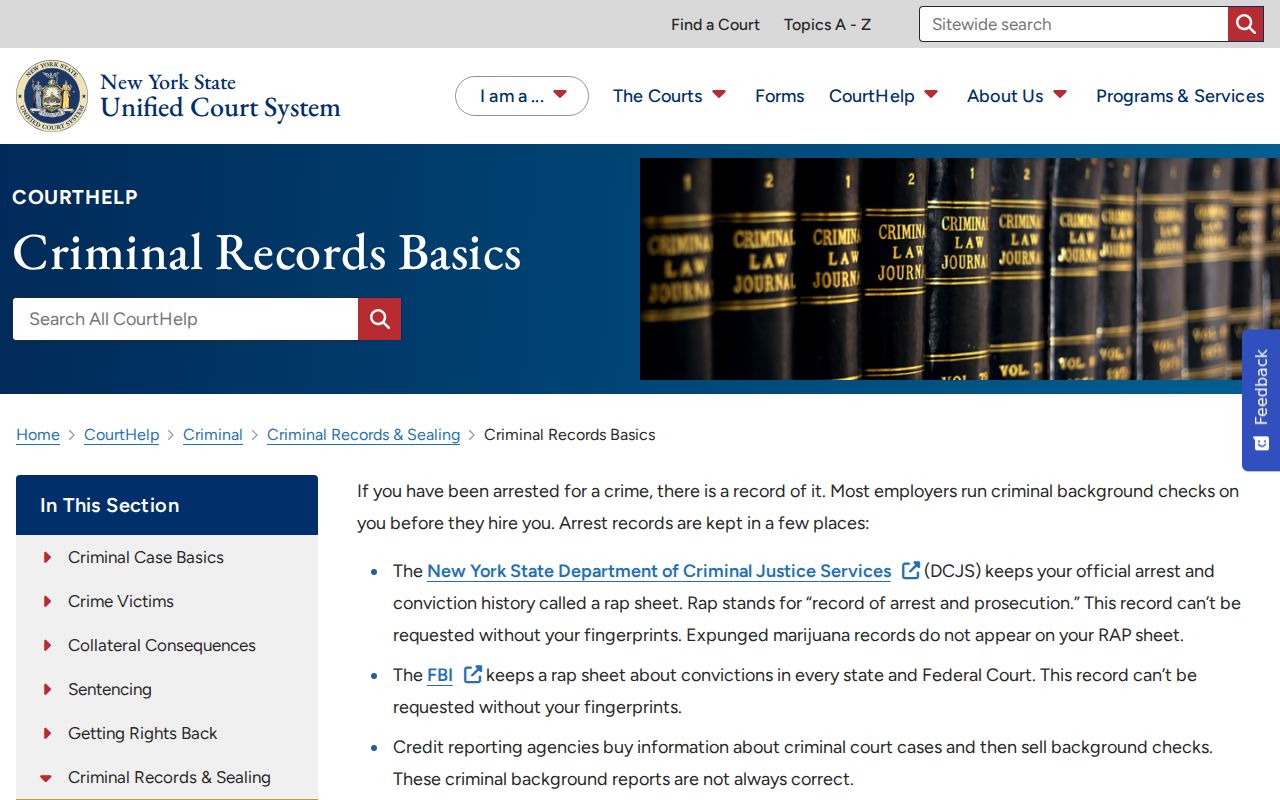
The image reinforces the key distinction: online indexes help locate a file, while the original court supplies certified proof and fuller papers.
Note: A missing online result does not establish that no Seneca County criminal case exists.
What the Case File Shows
A Seneca County criminal case file follows charges as they are filed and resolved. It is not the arresting officer's complete incident report. The docket can show how an allegation changed after prosecutor review, which motions the judge decided, whether a plea or trial resolved each count, and what sentence followed. Specific documents may add details that a short online entry omits.
| Court and docket | The court of jurisdiction and its case identifier. |
|---|---|
| Accusatory instrument | The complaint, information, indictment, or superior-court information that files charges. |
| Charges | Each filed count and its New York statutory section. |
| Appearances and orders | Scheduled dates, judge, motions, hearings, and court rulings. |
| Outcome | Plea, verdict, dismissal, acquittal, and disposition date by count. |
| Sentence | Custody, probation, fine, restitution, or other recorded terms. |
| Restricted material | Sealed events and protected victim, youth, juror, or identifier data are excluded. |
Read charge, disposition, and sentence as separate fields. A complaint states an allegation, a disposition states how a count ended, and a sentence records the order imposed after a conviction. A dismissal on one count does not describe another count, so request the full docket or certificate instead of relying on a single status label.
Seneca County Criminal Dispositions
A certificate of disposition is the certified court statement of a case outcome. CHRS cannot issue it. Request the certificate from the Seneca County court where the case was decided, even if a later felony proceeding occurred elsewhere. The record should tie the docket to its final counts, disposition, and sentence. That makes it the useful source when an old online result is vague or a person's own DCJS record lacks the reported outcome.
The County Clerk at 1 DiPronio Drive is Clerk of Supreme Court and County Court and preserves indexes and filed papers. Its advertised online-records link covers land records, not a criminal name search. Call 315-539-1771 before using the hallway drop box so staff can confirm whether the County Clerk or the Supreme and County Court chief clerk handles the specific paper. Consult the official clerk fee schedule, then confirm the exact product and any copy or certification fee before ordering.
The official Seneca County Clerk page is shown in the captured view below.
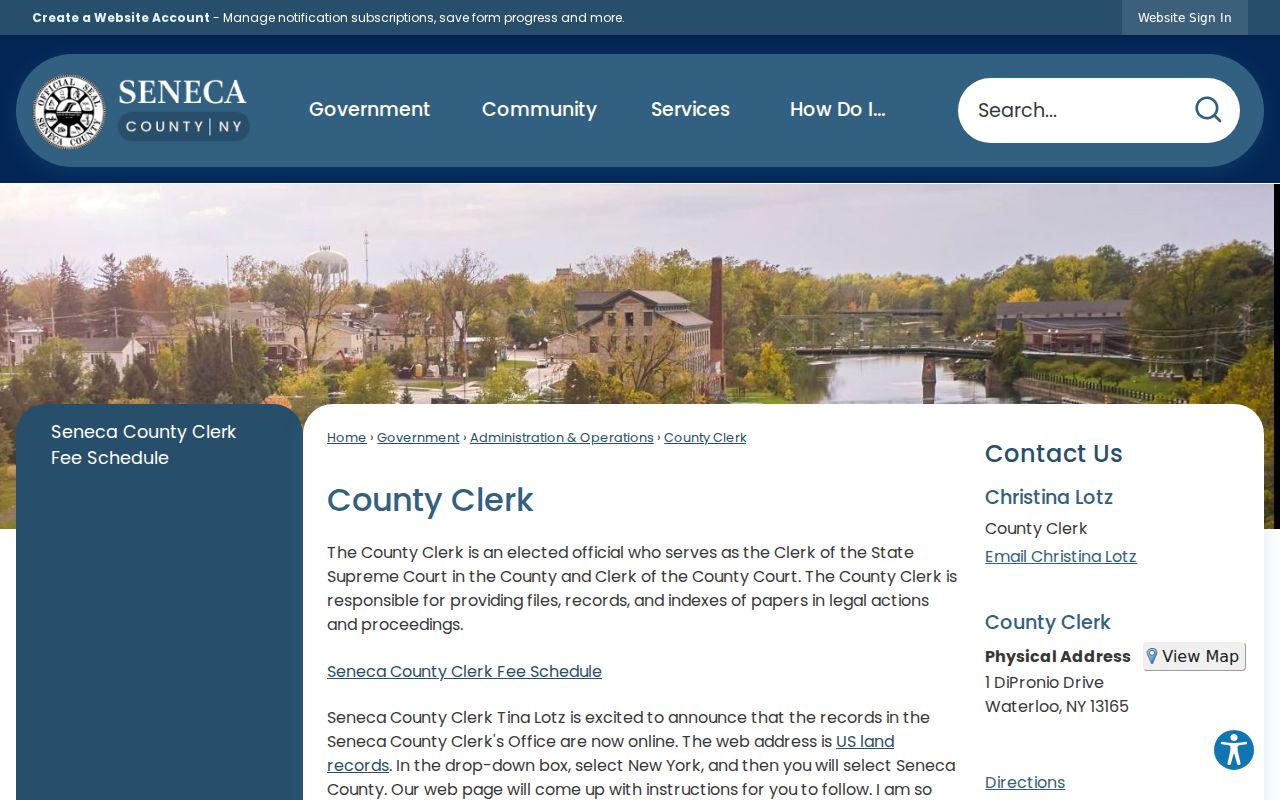
Its service listing is a starting point for contact, not a substitute for verifying which criminal clerk holds the docket.
Stages of a Criminal Case
A custody case may begin at the Centralized Arraignment Part in the Sheriff's lobby, which operates twice daily. A Seneca County justice court can arraign the complaint and address release conditions. Prosecutors then decide which counts to pursue. A felony that proceeds beyond the local preliminary stage moves to County Court, where an indictment or permitted superior-court information supports the prosecution.
Case flow: Charges Filed › Arraignment › Pretrial › Plea or Trial › Disposition › Sentencing
Each stage can leave a distinct entry. Arraignment records the charge and release decision. Pretrial filings may include motions and orders. A plea or verdict resolves particular counts, while the disposition records how each count ended. Sentencing records the court's order after conviction. The Seneca County District Attorney prosecutes local crimes from 44 West Williams Street, but the certified outcome remains with the Seneca County court. Reading those fields separately avoids mistaking an original accusation for the final result.
Seneca County Drug Treatment Court
Seneca County Drug Treatment Court operates through County Court at the Waterloo courthouse. It is part of the same Seneca County court system, not a separate public criminal-history database. Case status and the public portions of orders remain questions for the County Court clerk. Treatment or supervision details may be restricted even when the docket records a court appearance or outcome.
This distinction matters when a docket uses a program name. Participation does not erase the need to read each filed charge and disposition. Nor should a program reference be taken as proof that all clinical records are open. Ask for the public docket and name the exact order or certificate needed.
Older Seneca County Case Gaps
CHRS coverage has known time limits for town and village dispositions. Those results are unavailable for May 1991 through 2002, limited from 2002 through 2007, and expected from May 2007 forward. The absence of an older local outcome from CHRS therefore calls for a Seneca County clerk search, not a conclusion that the matter never existed. Archived and nonelectronic files may require counter inspection or a mail request.
Give the Seneca County clerk the full name used at the time, an approximate date, likely court, and any docket or ticket number. Ask about search, copy, and certification fees before sending payment. If the case began in a justice court and later moved, check both courts for the portions each created. A filed criminal case has its own history across those offices.
Access & Restrictions
Court access follows Judiciary Law section 255 and court rules rather than the ordinary executive-agency FOIL route. Clerks search, copy, and certify court records as authorized. The CourtHelp sealing overview and statewide criminal forms cover procedures outside ordinary public access. A public docket may still exclude sealed cases, youthful-offender adjudications, juvenile matters, grand-jury material, Social Security numbers, and protected victim or minor data.
New York sealing laws include CPL 160.50 for favorable terminations and CPL 160.59 for eligible conviction applications. Sealed matters do not appear in ordinary public searches.
CHRS also omits Family and federal cases, noncriminal violations, youthful-offender matters, specified pardoned or marijuana outcomes, and some dormant data. The courthouse accessibility page provides the official accommodation contact for an in-person file visit. For a public Seneca County case that cannot be found, contact the likely clerk and describe the file narrowly. For a certified result, use the original court. Arrest allegations and booking details remain separate records, with a fuller county process described in the Seneca County arrest history resource.
Note: A court file records filed proceedings and outcomes, while a police report preserves the agency's incident narrative.